After completing initial Hazardous Waste Operations and Emergency Response Standard training under 49 CFR 172.700, refresher training is required every three years. In this course, participants review material classifications, hazard communication and requirements for loading and unloading, as well as any changes to DOT regulations.
Registration
- $200
- Register online
Under the HAZWOPER regulation 29 CFR 1910.120, workers who have completed the 40-Hour Site Worker course must receive eight hours of refresher training every year. This course fulfills that requirement. Participants review hazard analysis and recognition and review new regulations.
Requirements
- Registrants must provide proof of successfully completing the 40-hour or 24-hour site worker course.
Registration
- $200
- Register online
This class fulfills the OSHA recommendations for training First Receivers, as defined in OSHA Best Practices for Hospital-Based First Receivers of Victims from Mass Casualty Incidents Involving Release of Hazardous Substances (January 2005).
The class is divided into four modules: HAZCOM awareness, decontamination practices, practical exercises in decontamination procedures and use of PPE.
Schedule Training
Email healthsafety@tennessee.edu to schedule a training.
This course covers and tests all the subjects needed to fulfill the U.S. Department of Transportation requirement 49 CFR 172.704(d)(5). Under DOT regulations, employees who impact the shipping and receiving of hazardous materials must be trained and tested, then certified by their employer. This includes workers who prepare or sign hazardous materials/waste manifests, workers who prepare hazardous materials for shipment off-site and hazardous waste generators.
Registration
- $350
- Register online
If you are required to physically approach and plug, patch or otherwise stop the flow of a hazardous substance, according to 29 CFR 1910.120 (q)(6)(iii), you must be trained to the level of technician. In this hands-on course, participants learn to:
- Manage a hypothetical emergency.
- Implement a response plan.
- Identify and classify spilled materials.
- Use personal protective equipment.
- Decontaminate the site.
Schedule Training
Email healthsafety@tennessee.edu to schedule a training.
During a full week of lectures, exercises and hands-on demonstrations, participants learn about:
- How to work safely around hazardous materials and wastes.
- Hazard recognition.
- Personal protective equipment and monitoring.
- Rights and responsibilities under OSHA.
This course meets the training requirements of the Hazardous Waste Operations and Emergency Response Standard (HAZWOPER) regulation, 29 CFR 1910.120(e)(3)(i). All students participate in full dress-out exercises using personal protective equipment.
Requirements
Students must complete a medical evaluation form and bring it to class.
Registration
- $750 (Government employees may be eligible for a discounted course rate.)
- Register online
This course covers the basics of an incident command system, including:
- How to design a system.
- Standard operating procedures.
- Hazard and risk evaluation.
- Site management and control.
- Media relations.
- How a system works with local, state and federal incident management plans.
Schedule Training
Email healthsafety@tennessee.edu to schedule a training.
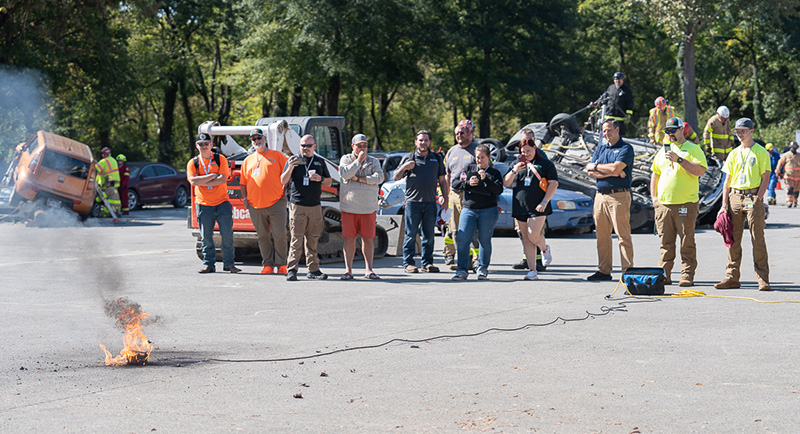
This two-hour course educates workers and community members on the potential hazards associated with lithium batteries. It provides an overview of safe handling practices and appropriate emergency response procedures. Participants gain an understanding of how lithium batteries can be damaged and the serious consequences that may result.
Schedule Training
Email healthsafety@tennessee.edu to schedule a training.
The four-hour course provides an in-depth overview of lithium-ion battery technologies, with a specific focus on the hazards associated with their use, storage and failure. The course explores the fundamental principles behind lithium-ion batteries. Participants gain a better understanding of chemistry and design variations of lithium-ion batteries in electric vehicles, energy storage systems (ESS) and consumer electronics.
Schedule Training
Email healthsafety@tennessee.edu to schedule a training.
This eight-hour course includes all content from the standard four-hour training on lithium battery hazards, safe handling practices and emergency response procedures. In addition to the foundational material, the course provides an expanded exploration of advanced topics relevant to energy storage systems (ESS).
Participants delve deeper into the chemistry of cell failure, thermal runaway and related failure mechanisms. The course also introduces applicable requirements from NFPA 855, with a focus on how these standards apply to the installation and operation of ESS. To enhance practical understanding, real-world incident case studies are presented to highlight key risk factors and lessons learned. The course further examines current hazard mitigation tools available on the market, evaluating their strengths and limitations to support informed decision-making.
This extended training is ideal for professionals seeking both foundational knowledge and a deeper understanding of technical and regulatory aspects of lithium battery safety.
Schedule Training
Email healthsafety@tennessee.edu to schedule a training.