Health and Safety Training
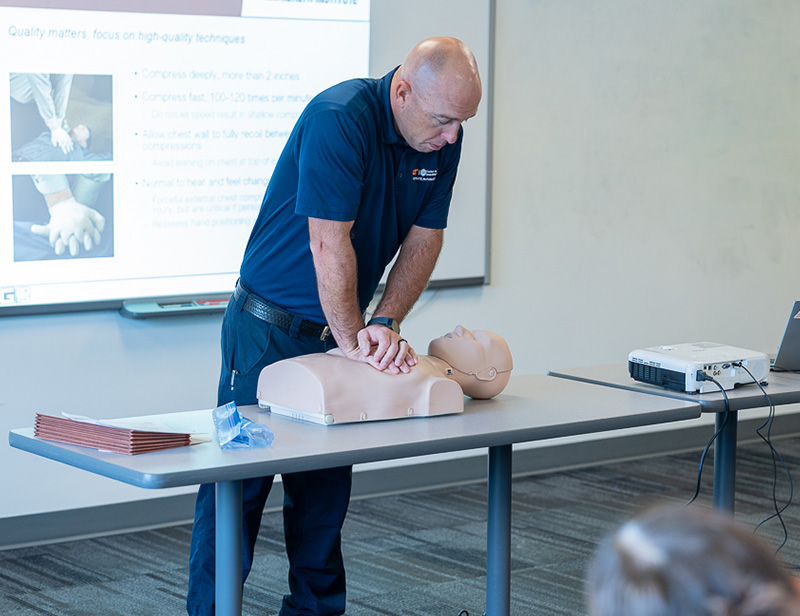
Enhance your organization's dedication to employee and workplace health and safety. UT CIS offers open enrollment programs across the state several times a year. All courses are taught by highly qualified, experienced instructors with decades of experience. We have a variety of programs and can create custom programming to meet the needs of your organization.
Our expert staff provides the most current information, techniques and best practices available to help you meet, or exceed, state and federal OSHA requirements.
Train at Your Facility
Save travel costs and minimize disruption by training at your facility. Our team offers onsite training to a variety of manufacturing, public works, utility, healthcare and public and private sector organizations.
We can customize classes and programs to help you meet regulatory requirements or organizational goals.
Schedule Training
Email us at healthsafety@tennessee.edu to schedule training.
Upon completing this class, the basic qualified rigger will be able to:
- Inspect rigging.
- Use various types of rigging equipment and basic hitches.
- Recognize associated hazards and signal operations.
- Identify and describe the use of slings and common rigging hardware, basic inspection techniques and rejection criteria used for slings and hardware.
- Demonstrate proper use of American National Standards Institute (ANSI) hand signals.
- Describe basic hitch configurations, proper connections and basic load-handling safety practices.
After successfully completing this class, students are qualified in basic rigging and signaling for updated OSHA crane standards.
This course is relevant for new hires, those entering an industry where they are working at heights or personnel who provide safety oversight.
This course covers:
- Awareness of scaffold safety
- Basic fall protection
- Equipment inspection
Falls are one of the most common causes of deaths and injuries to workers in the U.S. Participants learn how to work at heights safely to prevent injuries and fatalities.
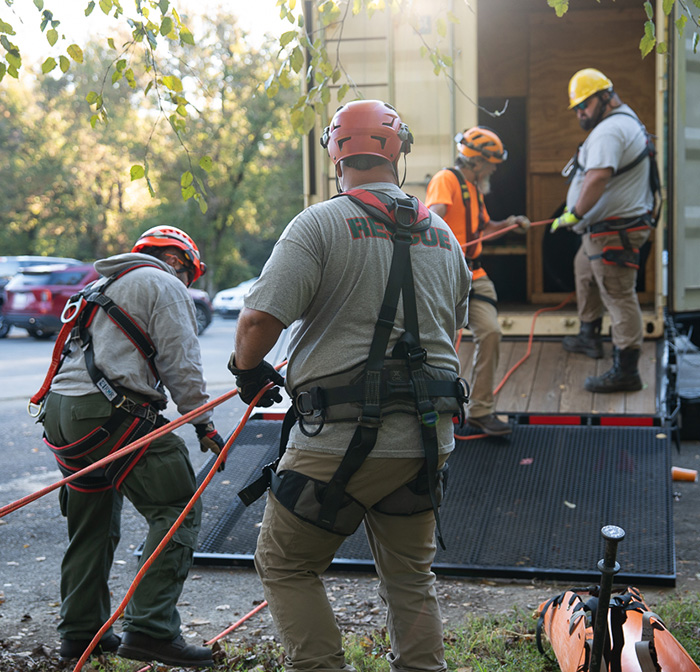
This training course is for any personnel who work at heights in construction or general industry. The course teaches the basics of self-rescue as well as assisting a fall victim. Participants expand their rescue skills, as well as better understand the requirements of rescue for OSHA, ANSI and CSA. Participants engage in practical, hands-on work and should dress accordingly.
This course can be tailored to your setting to ensure the training is specific to your organization.
The objective of this four-hour workshop is to examine successful safety committee strategies used by Tennessee companies. Participants examine issues such as:
- Roles of safety committees.
- Energizing the committee and program.
- Interaction of top management and supervisors with the committee.
- VPP (Voluntary Protection Program) and SHARP (Safety and Health Achievement Recognition Program) safety committee requirements.
A mock OSHA Audit is a complete audit covering the same activities as a real audit. It is designed to identify gaps in your safety program. We meet you on-site, walk through the job site and review policies and procedures. After the audit, we provide a thorough written report that includes our observations made during the walkthrough, including areas for improvement.
Our team of experts can write, update and advise on HSE policies and procedures for your organization, including machine specific lockout/tagout (LOTO) procedures. We help you determine which regulations apply and address any questions related to health and safety requirements.
This course covers the responsibilities of the excavation "competent person" as spelled out in OSHA 29 CFR 1926.650. Students learn:
- OSHA-accepted soils classification methods.
- Types of testing required.
- How to select protective systems.
- The elements of an excavation safety program.
OSHA regulation 29 CFR 1910.146(g) requires an employer to train employees who enter, attend to or supervise confined spaces. In this introductory course, participants learn:
- How to identify confined spaces.
- The major confined space hazards.
- Principles of ventilation.
- Entry permitting.
- Requirements of a permit-required confined space program.